FXEM - EMPIRE MARKETS - Company New Article
To access the website's classic version and the new accounts, please click here
Apr 08, 2026
Does USD Weakness Support a Rally in Currencies and Equities?
The impact of the war on currencies and commodities and the decline of the US dollar
USD Movements and Their Impact on Global Markets
Financial markets have witnessed notable movements in the US dollar’s performance recently, as it faces relative pressure against major currencies, driven by shifts in monetary policy expectations and improving investor risk appetite.
This weakness has been clearly reflected in major currency performance, with both the euro and the British pound posting strong gains, supported by buying flows and sustained positive momentum. Meanwhile, the dollar shows mixed performance against the Japanese yen, amid increased demand for safe-haven assets.
Impact of War on Other Markets
In other markets, US equities have benefited from the weaker dollar, enhancing the appeal of risk assets, while precious metals continue to trade near key resistance levels, supported by ongoing market uncertainty.
The decline in the US dollar also comes amid escalating geopolitical tensions, as ongoing conflicts increase uncertainty, prompting investors to rebalance portfolios and partially move away from the dollar toward other assets and currencies.
Trump’s Statements
The US dollar’s decline followed statements by Donald Trump, in which he announced a temporary two-week ceasefire agreement with Iran, along with a willingness to continue negotiations and de-escalate tensions. This boosted market risk appetite and encouraged investors to move away from the dollar as a safe haven.
Additionally, his shift away from previous aggressive rhetoric, which included strong threats toward Iran, helped ease geopolitical concerns, leading to a shift in flows toward risk assets such as major currencies and equities at the expense of the dollar.
In this broader context, investor risk sentiment continues to play a key role, with flows shifting toward equities and major currencies during periods of dollar weakness, while safe-haven demand rises during heightened uncertainty.
Oil Reaction to De-escalation
In a related development, the easing of geopolitical tensions following the ceasefire announcement has weighed on oil prices, which came under selling pressure as concerns over supply disruptions declined.
Oil is highly sensitive to geopolitical developments, and reduced escalation risks tend to lower the risk premium, pushing prices lower.
This decline in oil aligns with improving risk sentiment, as flows move toward risk assets, reinforcing the broader picture of a weaker dollar alongside rising currencies and equities.
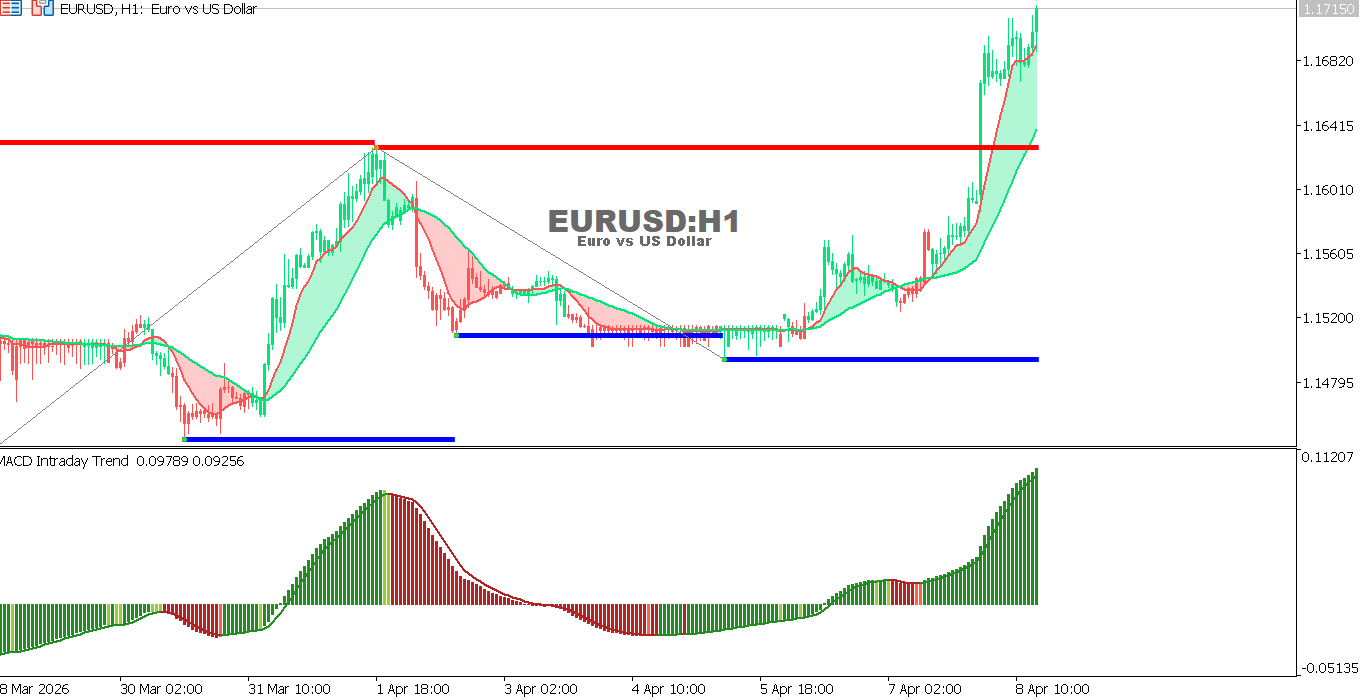
A technical look at the EURUSD pair on the hourly timeframe
EURUSD is trading near the 1.1700 level after a clear breakout above the 1.1630 resistance, supporting continued upside in the short term.
Momentum shows noticeable improvement, with the MACD indicator moving in positive territory and accelerating buying pressure, reflecting bullish control over price action.
- Trend: Bullish
- Support: 1.1630 – 1.1580
- Resistance: 1.1700 – 1.1720
Outlook: Holding above 1.1630 supports further gains, while a break below may trigger a downside correction.
Expected Scenarios
Bullish Scenario:
Sustained trading above 1.1630 may push the pair toward 1.1720 and 1.1750, supported by continued USD weakness and positive momentum.
Bearish Scenario:
A break below 1.1630 could lead to a corrective move toward 1.1580, especially if USD demand returns or risk appetite weakens.
⚠️ Risk Factors
Markets remain vulnerable to volatility amid ongoing geopolitical tensions, in addition to any unexpected statements from policymakers or shifts in monetary policy expectations, which may directly impact the direction of the US dollar and related assets.