FXEM - EMPIRE MARKETS - Company New Article

To access the website's classic version and the new accounts, please click here

Feb 23, 2026

XAU/USD chart on the weekly time frame

XAU/USD chart on the weekly time frame

Following a two-week period marked by elevated volatility and heightened trading volume in late January, the subsequent two weeks exhibited a pronounced contraction in volatility, accompanied by a third consecutive weekly decline in trading volume. 

As highlighted in the previous weekly report and corroborated by the Average Directional Index (ADX) on the weekly timeframe, gold has entered a consolidation phase, with the trading range over the past week closely mirroring that of the preceding week. 

Amid ongoing geopolitical tensions, gold may extend its short-term recovery beyond the 61.8% Fibonacci retracement level, estimated at approximately $5,140, toward the $5,200 zone. 

As the monthly technical indicators continue to favor a medium-term correction, the $5,140–$5,200 range presents a strategic opportunity to close long positions and establish new short positions. 

A neutral outlook would only be warranted upon a daily close above $5,200, while a bullish reversal would require a decisive breakout above the $5,600 resistance level—a scenario currently assigned a probability of less than 5%.


EURUSD Chart on the weekly time frame

EURUSD Chart on the weekly time frame

Following the formation of the most recent peak in the EUR/USD pair, a new medium-term bullish channel has been delineated, characterized by the alignment of the last three major highs and the parallel alignment of the last four major lows. 

While momentum oscillators such as the Relative Strength Index (RSI) offer no definitive signal regarding the pair's intermediate-term trajectory, volume dynamics on the weekly chart exhibit constructive characteristics, with observable expansion during upward advances and contraction during corrective phases. 

Consequently, the trading strategy will remain anchored to the recently established price channel, advocating for accumulation near the lower boundary and distribution near the upper boundary. 
The protective stop-loss is presently positioned at 1.1570.


USTEC chart on the weekly time frame

USTEC chart on the weekly time frame

Following a rebound from the lower threshold of the established sideways trading range—defined between approximately 24,000 and 26,200 points—the USTEC index concluded the week with marginal gains, albeit on significantly below-average volume. 

Given the mixed signals currently emanating from key technical indicators, the prevailing range-bound configuration is expected to persist for an additional two to three weeks. 

While an attempt to test the upper boundary may materialize in the near term, such a move is anticipated to present an opportunity to initiate new short positions. 

Consequently, the established range-bound strategy—selling near resistance and buying near support—remains valid. 

A decisive breach beyond either boundary will be required to determine the index's subsequent medium-term directional bias.
 

USD chart on the weekly time frame

USD chart on the weekly time frame

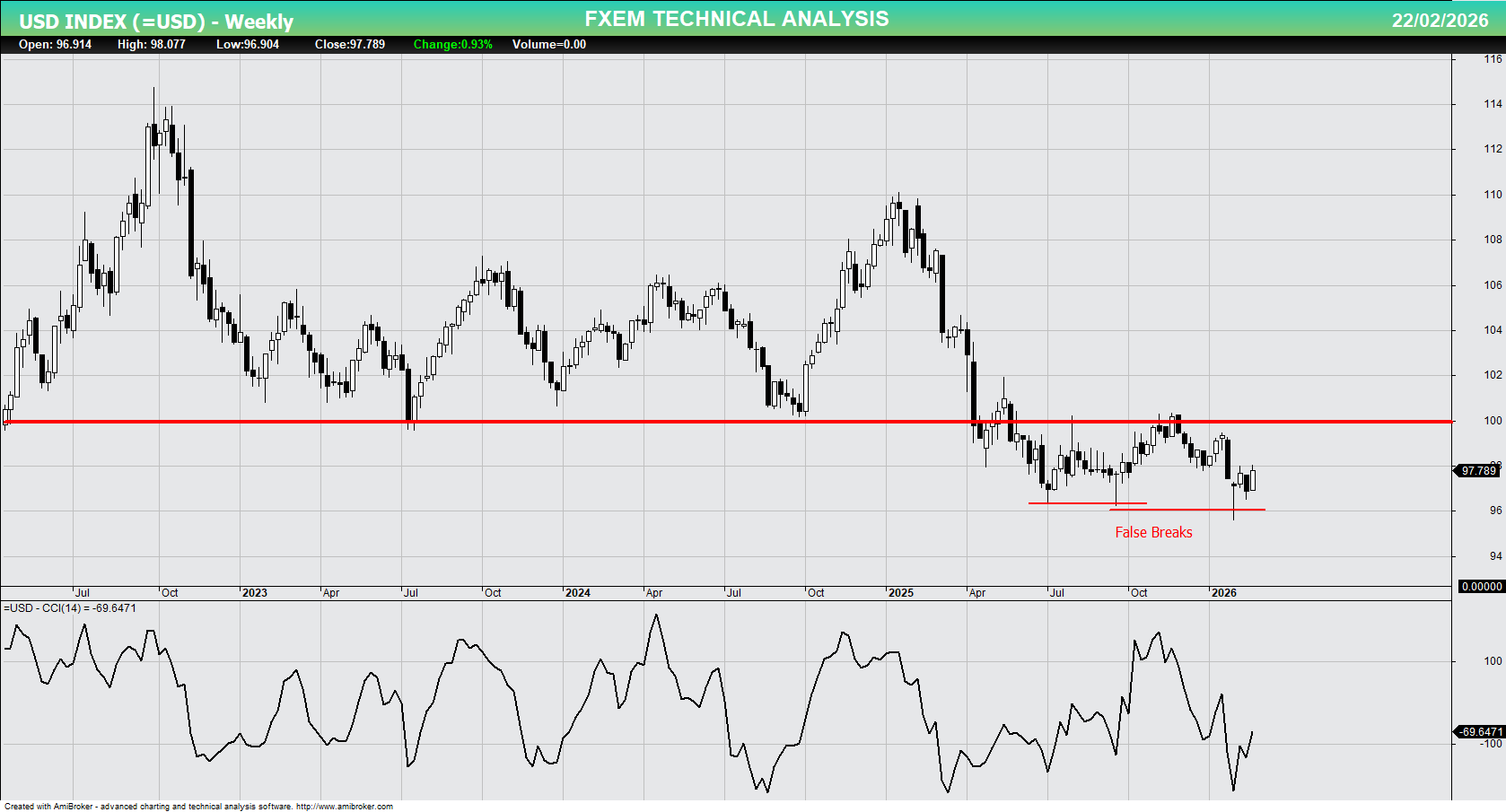
The U.S. Dollar Index is exhibiting a long-term bearish structure, having decisively broken below the 100.00 threshold in the prior year. However, on the medium-term horizon, the index has entered a consolidation phase, establishing a support base near the 96.75 level. 

Price action below this threshold has consistently been rejected, resulting in a series of bullish false breakdowns, which reinforces the significance of this support zone. 

Concurrently, near-term technical oscillators, such as the Commodity Channel Index (CCI), are displaying positive divergence and have generated a buy signal. This is complemented by the formation of a higher low on the daily chart, suggesting a build in upward momentum. 

Consequently, the index is positioned to extend its corrective recovery, with the primary resistance zone near the 100.00 mark representing a key target in the coming weeks. 

Such a recovery in the U.S. Dollar would likely exert downward pressure on the EUR/USD pair, potentially driving it towards the lower boundary of its bullish price channel, identified at the 1.1620 level. 

The following charts will analyze the relative strength of the major currency pairs to identify the most strategically advantageous long and short opportunities for the upcoming period.


The Indirects (EUR/USD, GBP/USD, NZD/USD)

The Indirects (EUR/USD, GBP/USD, NZD/USD)

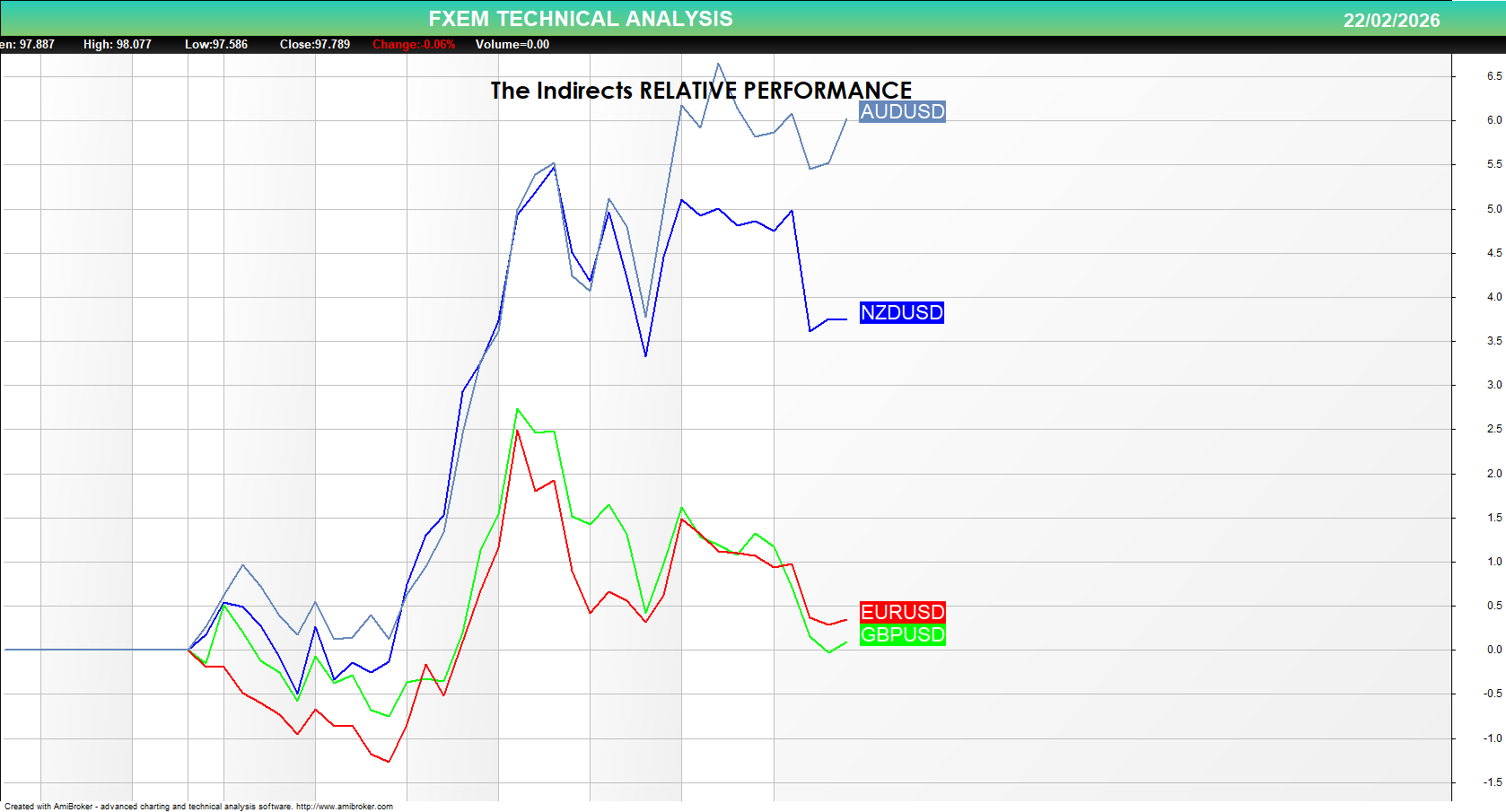
Based on the relative performance data, long positions triggered by bullish signals are more effectively allocated to AUD/USD and NZD/USD, as these pairs exhibit superior strength. 
Conversely, short positions on bearish signals are better executed on EUR/USD and GBP/USD, which demonstrate more pronounced relative weaknesses. 


The Directs (USD/CAD, USD/CHF, USD/JPY)

The Directs (USD/CAD, USD/CHF, USD/JPY)

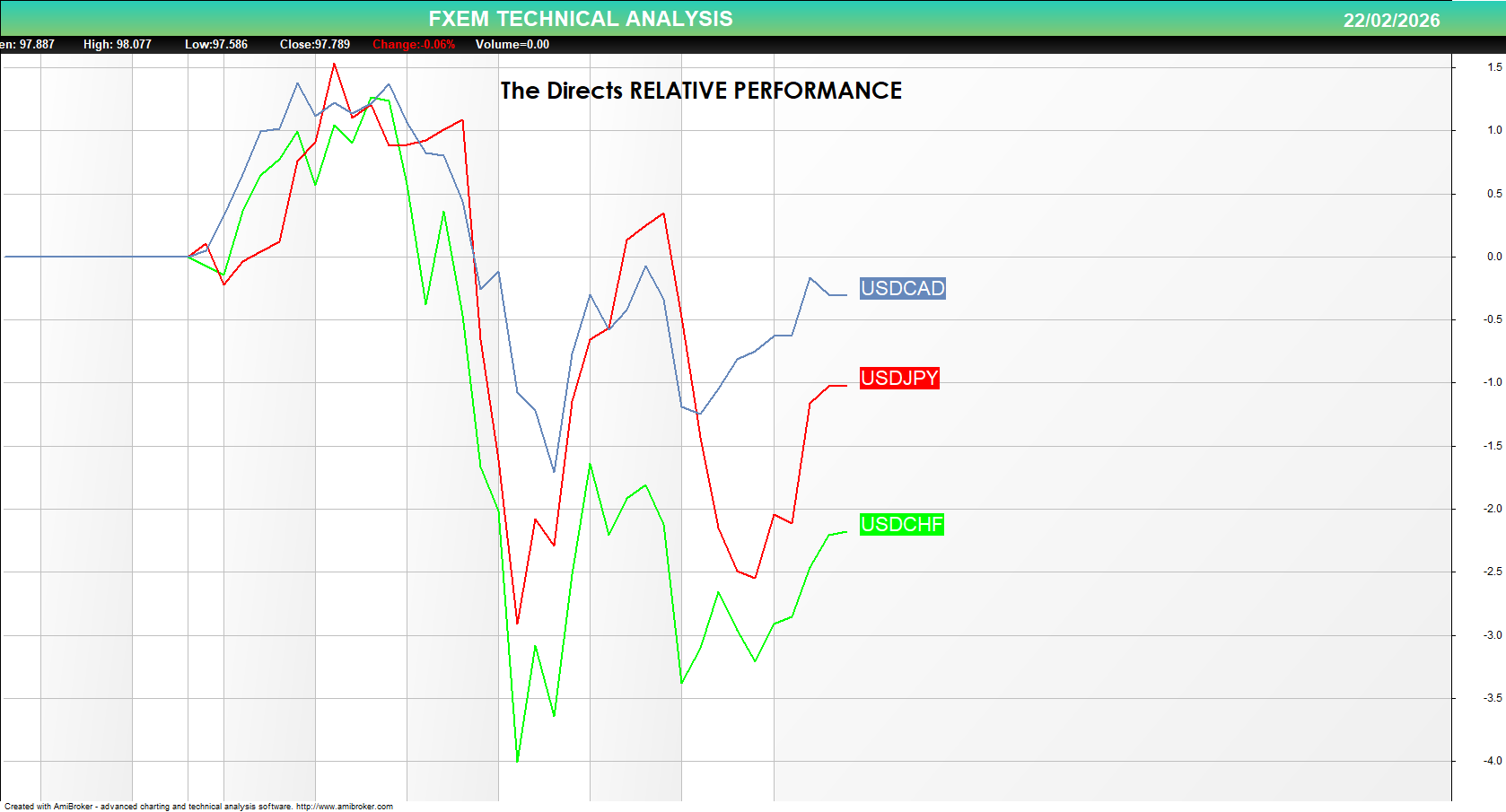
Based on the relative performance data, long positions triggered by bullish signals are more effectively allocated to AUD/USD and NZD/USD, as these pairs exhibit superior strength. 
Conversely, short positions on bearish signals are better executed on EUR/USD and GBP/USD, which demonstrate more pronounced relative weaknesses. 


To open Live account click here 

One Trading Account | 50+ Forex Pairs | 80+ Trading Instruments
Multi-Asset Trading Platforms

Cookie Policy
This website uses cookies to ensure you get the best experience on our website. We use cookies for proper website navigation and function and for statistical and analytical purposes. You can select the cookie categories that you would like to manage through the Cookies Settings at any time. Please configure your Cookies Settings before proceeding. To learn more, please read our Cookies Policy